Introduction
Optical accessories can change the way a user observes a target through compatible sporting or recreational equipment. A traditional scope provides magnification and a reticle, while a red-dot sight offers a different style of aiming reference. A laser accessory adds another visible reference point. Combining several of these functions into one package can make a scope setup more versatile, particularly for users who want multiple optical and sighting options without purchasing every component separately.
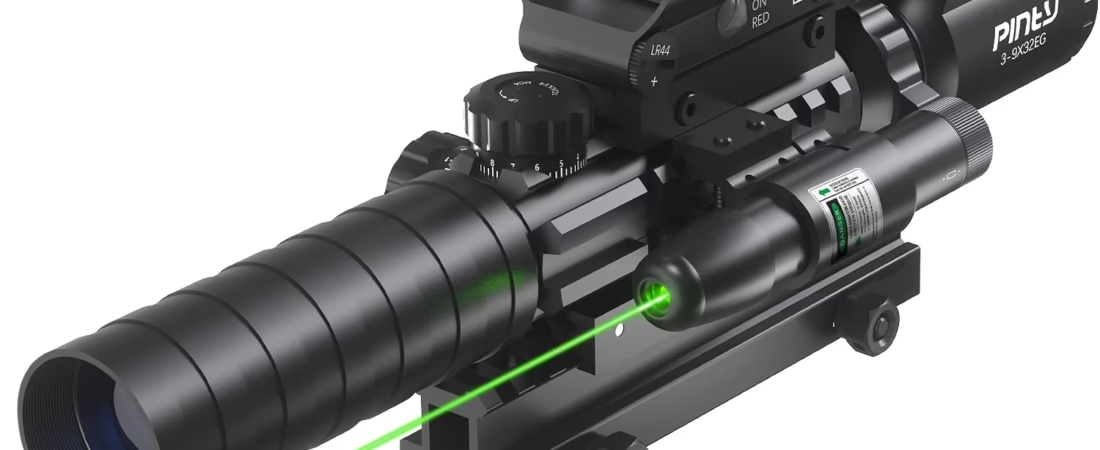
The PINTY Rifle Scope Combo Set is described as a multi-in-one tactical illuminated scope package that includes an illuminated riflescope, red and green dot functionality, and a laser sight. The product is designed for equipment using compatible 20mm Picatinny or Weaver-style rails and is marketed for applications including hunting, shooting, and airsoft.
Because the package combines several different sighting technologies, understanding what each component actually does is more useful than focusing on the number of included accessories. A magnified scope, illuminated reticle, dot-style aiming reference, and laser sight each serve different purposes and have different strengths and limitations.
It is also important to distinguish between equipment intended for sporting or recreational use and professional-grade optical systems. Product specifications can describe the design and intended compatibility of an accessory, but they do not guarantee a particular level of accuracy or performance in every environment.
This guide explains the major components of the PINTY combo set, how they fit into the broader category of optical accessories, what compatibility considerations matter, and what users should understand before selecting or handling this type of equipment.
Any firearm-related use should always follow applicable laws, manufacturer instructions, range rules, and fundamental firearm-safety practices. For airsoft or other recreational platforms, users should likewise follow the equipment manufacturer’s instructions and appropriate protective-equipment requirements.
What Is the PINTY Rifle Scope Combo Set?
The PINTY package belongs to a category of multi-component optical accessories.
Instead of providing only a conventional magnified scope, the package combines several sighting elements in one configuration.
The product description identifies features including:
- An illuminated riflescope
- Red and green illuminated aiming options
- A dot-style sight
- A laser sight
- Mounting compatibility with 20mm Picatinny or Weaver-style rails
- Use in hunting, shooting, and airsoft contexts
The idea behind a combo set is flexibility.
A user may want a magnified optical view for distant observation, while another situation may call for a simpler illuminated aiming reference. A laser provides yet another visual reference, although its appropriate use depends heavily on the equipment, environment, local rules, and safety considerations.
The individual components should therefore be understood separately before considering the complete package.
Key Features
Illuminated Rifle Scope
The primary optical component is a magnified scope with an illuminated reticle.
A traditional riflescope uses lenses to enlarge a distant scene and presents a reticle within the optical image.
An illuminated reticle adds a light source to the reticle itself.
This can make the aiming reference easier to distinguish against certain backgrounds and lighting conditions.
Illumination is not the same as increasing optical magnification.
The scope’s magnification determines how large the viewed scene appears.
The illuminated reticle determines how the reticle is visually presented.
These two functions operate independently.
Red and Green Illumination
The combo is described as offering red and green illuminated reticle or dot options.
Different illumination colors can be useful in different visual environments.
A particular color may contrast more clearly against a dark or light background, although the effectiveness depends on the surroundings and the user’s eyesight.
Illumination brightness is also important.
An overly bright reticle can obscure details in a darker environment, while insufficient illumination may be difficult to distinguish against a complicated background.
The ability to select between colors provides an additional adjustment option.
Dot-Style Sight
A dot sight uses a relatively simple illuminated reference rather than a traditional magnified crosshair pattern.
Dot-style sights are common in recreational shooting and airsoft because they provide a straightforward visual reference.
Unlike a magnified scope, a dot sight does not necessarily enlarge the target.
Its purpose is to provide an aiming reference that can be seen against the viewed background.
This makes the dot concept different from the magnification function of the primary scope.
Laser Sight
The package also includes a laser sight.
A laser produces a visible point of light at a distant surface.
This is fundamentally different from a scope reticle.
The reticle is seen through the optical system.
The laser is projected into the environment.
Because lasers can create safety concerns, users should take particular care with their handling.
A laser should never be intentionally directed toward a person’s eyes, aircraft, vehicles, or other inappropriate targets. Applicable laws and local regulations should also be checked because laser-sight use can be regulated differently depending on the jurisdiction and application.
For recreational environments such as airsoft, range operators may also have specific rules concerning lasers.
20mm Picatinny/Weaver Compatibility
The product is described as compatible with 20mm Picatinny Weaver-style rails.
Rail compatibility is one of the most important practical considerations when selecting an accessory.
A mounting system needs to match the rail dimensions and interface of the equipment.
Picatinny and Weaver-style rails can appear similar, but they are not necessarily identical in every dimensional detail.
Users should verify the rail specification of the equipment before assuming that a mount will fit.
The fact that a product is marketed as “20mm compatible” should not be interpreted as universal compatibility with every rail that appears visually similar.
Multi-Component Configuration
The main attraction of a combo package is that several optical functions are provided together.
Instead of selecting a scope, dot sight, and laser separately, the user receives a coordinated accessory package.
This can simplify the process of assembling a compatible recreational setup.
However, multiple components also mean more controls, more batteries or power considerations, additional mounting hardware, and more opportunities for compatibility issues.
A multi-function package is therefore most useful when the user understands what each component contributes.
Understanding Magnified Scopes
A magnified scope works by collecting incoming light through an objective lens and passing that information through an optical system.
The image is enlarged before reaching the user’s eye.
Magnification can make distant objects easier to observe, but higher magnification does not automatically produce more useful information.
Several factors influence the final image:
- Lens quality
- Light transmission
- Optical coatings
- Field of view
- Eye relief
- Atmospheric conditions
- Stability
- Focus
- Target contrast
A magnified scope also has a narrower field of view as magnification increases.
This means that a highly enlarged image can make it more difficult to locate a moving object.
For this reason, magnification should be viewed as a tool rather than as a measurement of overall optical quality.
Understanding Illuminated Reticles
An illuminated reticle adds light to a conventional aiming pattern.
There are several reasons manufacturers include illumination.
One is visibility.
A dark reticle can sometimes blend into a dark or complicated background.
Illumination can make the reticle easier to distinguish.
Another reason is user preference.
Some people find a colored aiming reference easier to identify than a traditional black reticle under certain lighting conditions.
However, illumination does not improve the optical resolution of the scope.
If the image itself is blurry, adding a brighter reticle will not make the distant scene clearer.
Similarly, a very bright reticle can become distracting if the brightness level is not appropriate for the surrounding light.
Red vs. Green Illumination
The PINTY combo is described as supporting red and green illumination.
The difference is primarily visual.
Red illumination can provide strong contrast in many environments, while green may appear more prominent against certain backgrounds.
Individual eyesight and lighting conditions play an important role.
There is no single color that will be equally comfortable for every person or every environment.
Users should choose the setting that provides a clear aiming reference without unnecessarily overpowering the viewed scene.
Understanding a Dot Sight
A dot sight is designed around simplicity.
Instead of a traditional crosshair, the user sees an illuminated dot or similar reference.
The dot itself does not physically point at a target.
It is simply a visual reference within the sighting system.
The user’s viewing position, the optical alignment, and the equipment’s orientation all affect where that reference corresponds relative to the equipment.
For this reason, a dot sight should be understood as an optical aiming interface rather than a device that independently determines where something will go.
Understanding Laser Sights
A laser sight projects a beam of light onto a surface.
This makes the laser visually different from an optic.
The user can see the projected point rather than looking through a scope to see an internal reticle.
Lasers can be useful for certain legitimate recreational applications, but they also require additional safety awareness.
Eye Safety
A laser should never be directed into a person’s eyes.
Even relatively low-powered lasers can present risks when viewed directly or at close range.
Never use a laser as a toy or point it at people.
Aircraft and Vehicles
Lasers should never be directed toward aircraft.
Depending on jurisdiction, shining lasers at aircraft or other moving vehicles can have serious legal consequences.
Indoor and Airsoft Use
Airsoft fields may have specific restrictions on laser accessories.
Some venues may prohibit them completely or impose requirements concerning laser power and operation.
Always follow the field operator’s rules.
How It Can Be Used
Recreational Airsoft
The product is marketed as compatible with airsoft applications.
In that context, an optical accessory can be used as part of a recreational equipment setup.
Airsoft users should follow field-specific rules and wear appropriate eye protection.
A laser should only be used when expressly permitted by the field and in accordance with its safety requirements.
Outdoor Sporting Applications
A magnified optic can be useful for lawful sporting applications where a compatible optical sight is appropriate.
The scope can provide magnified observation and an illuminated reticle can provide an additional visual reference.
Users should always follow the laws and regulations applicable to the equipment and activity in their location.
General Optical Observation
The magnified scope can also function as an optical viewing instrument in appropriate circumstances.
The ability to enlarge distant objects can be useful for general observation, provided the equipment is used safely and lawfully.
Training Environments
In supervised recreational settings, optical accessories can also be used to become familiar with different types of sighting technology.
Learning how magnification, field of view, reticle illumination, and dot-style references differ can help users understand the characteristics of various optical systems.
Any activity involving projectile-launching equipment should take place under appropriate supervision and safety procedures.
Who It May Be Suitable For
Airsoft Players
Airsoft users with compatible 20mm rails may be interested in a multi-function optical package.
The combination of magnification and dot-style sighting can provide different observation options depending on the configuration and activity.
Field rules should be checked before using a laser.
Outdoor Sporting Users
Users participating in lawful outdoor sporting activities may find a traditional illuminated scope format familiar.
The exact suitability depends on the host equipment, mounting system, local regulations, and intended application.
Recreational Optics Enthusiasts
People interested in experimenting with different sighting technologies may appreciate having several optical references in one package.
The combination provides an opportunity to understand how a magnified optic differs from a dot sight and laser.
Users With Compatible Rails
The package may be relevant to users whose equipment already has a compatible 20mm Picatinny or Weaver-style mounting interface.
Rail compatibility should be confirmed before installation.
Important Things to Consider
Verify Rail Compatibility
A scope or accessory cannot simply be assumed to fit every rail.
Check the host equipment’s rail dimensions and interface.
Picatinny and Weaver-style systems have similarities, but they are not interchangeable in every situation.
Confirm the Intended Equipment
The product should only be installed on equipment for which the manufacturer and accessory specifications indicate compatibility.
A mount that physically appears to fit does not necessarily mean that the complete system is appropriate.
Consider Total Weight
A combo package adds several components.
The combined weight can affect the handling characteristics of the equipment.
This is especially relevant for lightweight airsoft platforms or equipment carried over long distances.
Battery Management
Illuminated reticles, dot sights, and laser systems require power.
Depending on the specific configuration, multiple electronic functions may consume batteries independently.
Users should follow the product’s battery specifications and remove or replace batteries according to the manufacturer’s instructions.
Brightness Is Important
Illumination should be appropriate for the surrounding environment.
A very bright reticle can reduce visual contrast or become distracting.
A weak reticle may disappear against the background.
Magnification Changes the Field of View
Higher magnification provides greater image enlargement but narrows the field of view.
This is normal behavior for variable optical systems.
Atmospheric Conditions Affect Long-Distance Viewing
Haze, humidity, dust, rain, and heat shimmer can reduce image clarity.
Increasing magnification cannot remove atmospheric distortion.
Eye Relief Matters
A magnified scope should be used according to its specified eye-relief requirements.
Users should follow the manufacturer’s instructions and maintain safe positioning.
Laser Safety Requires Extra Attention
The laser component introduces risks that do not exist with a purely optical reticle.
Never point it toward people, aircraft, or other unsafe targets.
Follow Local Laws
Regulations concerning firearm accessories, lasers, hunting, airsoft, and other sporting equipment vary between jurisdictions.
Users are responsible for understanding and following the rules that apply where they live and where the equipment is used.
Comparison of General Categories
Magnified Scope vs. Red-Dot Sight
A magnified scope enlarges the viewed image.
A red-dot sight generally provides a simple illuminated aiming reference without magnification.
The scope can be useful when distant observation is important.
The dot sight provides a simpler optical interface.
Neither category is inherently appropriate for every application.
Red-Dot Sight vs. Laser
A red-dot sight is viewed through an optical device.
A laser projects a point into the surrounding environment.
The dot remains within the sight picture.
The laser point appears on an external surface.
This distinction also creates different safety considerations.
Illuminated vs. Non-Illuminated Reticles
A traditional non-illuminated reticle relies on contrast between the reticle and the background.
An illuminated reticle adds a visible light source.
Illumination can be helpful under certain conditions but requires power and appropriate brightness management.
Variable Magnification vs. Fixed Magnification
A variable scope allows the user to change magnification.
A fixed-power scope remains at one magnification level.
Variable magnification provides greater flexibility but introduces additional mechanical components.
Optical Scope vs. Digital Sight
An optical scope uses lenses to create the viewed image.
A digital sight uses an electronic sensor and display.
Digital systems can provide features such as electronic overlays, recording, and digital adjustments.
The PINTY combo follows the more traditional optical approach.
Optical Clarity and Real-World Expectations
Marketing terminology can sometimes make optical products appear simpler than they are.
Terms such as “high definition,” “tactical,” or “high power” do not independently define optical quality.
The final viewing experience depends on the entire optical system.
Lens Quality
High-quality optical glass can transmit light efficiently and preserve contrast.
Lens Coatings
Coatings can reduce reflections and improve light transmission.
Alignment
Optical components need to be properly aligned for the image to remain clear.
Lighting
The amount and direction of available light affect contrast.
Atmospheric Conditions
The atmosphere can significantly affect distant observation.
Stability
Movement becomes increasingly noticeable as magnification increases.
For these reasons, users should evaluate a scope using its complete specification set rather than relying on one marketing term.
Maintaining Optical Equipment
Keep Lenses Clean
Dust and fingerprints can interfere with clarity.
Use appropriate optical-cleaning materials.
Avoid rubbing abrasive particles across the lens.
Protect the Optics
When the equipment is not in use, lens covers can help protect optical surfaces.
A suitable storage case can also reduce the risk of accidental damage.
Protect Electronic Components
Illuminated sights and lasers contain electronic components.
Avoid unnecessary exposure to water, extreme temperatures, or impacts beyond the manufacturer’s specifications.
Check Battery Condition
Inspect batteries periodically.
If a device will be stored for an extended period, follow the manufacturer’s recommendations regarding battery removal or storage.
Inspect Mounting Hardware
Before use, check that mounting components are intact and properly matched to the rail.
Do not use damaged mounting hardware.
Why Rail Compatibility Matters
A rail is the interface between the host equipment and the accessory.
The PINTY product is described as compatible with 20mm Picatinny Weaver rails.
This terminology is useful but should be interpreted carefully.
A rail’s appearance is not always enough to determine compatibility.
Dimensions, slot arrangement, mounting interface, and accessory specifications all matter.
When purchasing an optical accessory, it is helpful to identify:
- The rail type on the host equipment.
- The rail dimensions.
- The mounting interface supplied with the accessory.
- The tube diameter where applicable.
- Whether additional adapters are required.
This prevents a common problem in optical accessories: having an optic that is otherwise suitable but cannot be mounted correctly to the intended platform.
Safety and Responsible Use
A product involving firearm or projectile-related equipment requires a higher level of care than ordinary consumer electronics.
Treat All Firearms as Loaded
Follow established firearm-safety principles whenever handling a firearm.
Never assume that a firearm is unloaded simply because someone says it is.
Keep the Muzzle in a Safe Direction
The direction of the equipment should always be controlled according to established safety rules.
Keep Fingers Away From the Trigger
Follow standard safety practices and keep the trigger area clear unless a lawful and appropriate shooting situation requires otherwise.
Know the Target and Surroundings
Before any lawful shooting activity, the user must understand the environment and what lies beyond the intended target.
Use Appropriate Eye Protection
Airsoft and shooting environments can involve projectile hazards.
Appropriate eye protection is essential.
Follow Range Rules
If the equipment is used at a shooting range, the range’s safety procedures take priority.
Laser Awareness
Never direct a laser toward people, aircraft, vehicles, or reflective surfaces where the beam could create a hazard.
Frequently Asked Questions
What is included in the PINTY combo set?
The product is described as a multi-in-one package containing an illuminated scope, red and green dot-style aiming functionality, and a laser sight, along with mounting components for compatible 20mm rails.
Exact package contents should be confirmed against the current Amazon listing and manufacturer’s documentation.
What type of rail is it compatible with?
The product is marketed for 20mm Picatinny or Weaver-style rails.
The specific rail on the host equipment should be checked before installation.
Does the scope have illumination?
Yes. The product description identifies illuminated aiming functionality with red and green options.
What is the purpose of the illuminated reticle?
Illumination can make the reticle easier to distinguish against certain backgrounds and lighting conditions.
It does not increase the optical resolution of the scope.
What is the difference between the dot sight and the scope?
The scope provides magnified optical viewing, while the dot sight provides a simpler illuminated aiming reference.
What does the laser sight do?
A laser projects a visible point onto a surface.
It is different from an internal scope reticle because the laser point exists outside the optical system.
Is the laser safe to point at people?
No.
A laser should never be intentionally directed into someone’s eyes or used irresponsibly around people.
Can the laser be used around aircraft?
No.
Lasers should never be directed at aircraft. Users should also follow all applicable laws concerning laser devices.
Can this setup be used for airsoft?
The product is marketed for airsoft applications.
Users should confirm compatibility with their particular airsoft platform and follow the rules of the airsoft field, especially regarding laser use and eye protection.
Does a magnified scope provide a wider field of view at higher magnification?
Generally, no.
As magnification increases, the field of view becomes narrower.
Does higher magnification always mean better performance?
No.
Higher magnification enlarges the image but can also make movement, atmospheric distortion, and focusing limitations more noticeable.
Does illumination improve image quality?
Not directly.
Illumination primarily improves the visibility of the reticle or aiming reference.
It does not automatically improve the optical resolution of the scene.
Can the red and green settings be used in any lighting?
They can be selected according to the available controls, but the most useful color and brightness can depend on the environment and individual eyesight.
Does the laser replace the scope?
No.
The laser and scope operate in different ways.
The scope provides an optical viewing system, while the laser projects a visible point.
Can a scope and dot sight be useful for different situations?
Yes.
They represent different sighting concepts. A magnified scope provides enlarged viewing, while a dot sight provides a simpler visual reference.
Is a 20mm rail the same as every Weaver rail?
Not necessarily.
Picatinny and Weaver-style rails share similarities, but their dimensions and slot specifications can differ.
Always verify compatibility rather than relying solely on the general appearance of the rail.
Can this product fit any firearm?
No.
Compatibility depends on the rail, mounting system, equipment configuration, and manufacturer specifications.
Users should verify the exact host platform before installation.
Can this product be used on airsoft equipment?
It is marketed for airsoft, but the exact rail and physical configuration should be checked before installation.
Does the scope require batteries?
The illuminated and electronic components require power.
The exact battery configuration should be checked in the current product documentation.
How should the optical lenses be cleaned?
Use appropriate optical-cleaning materials and avoid abrasive materials or excessive pressure.
Should the equipment be stored with batteries installed?
Follow the manufacturer’s storage recommendations. For long-term storage, battery care is particularly important.
Can the scope be used in rain?
The suitability of the product in wet conditions depends on its specific environmental specifications. Users should consult the manufacturer’s documentation rather than assume that a tactical-style design is waterproof.
Is this equipment suitable for hunting?
The product is marketed for hunting applications, but hunting laws vary significantly by jurisdiction. Users must verify licensing, equipment restrictions, seasons, and other applicable regulations before using it for hunting.
Is this product suitable for beginners?
The optical components may be understandable to someone new to scopes, but users should learn the relevant safety procedures before handling any firearm-related equipment.
For airsoft, users should follow the field’s equipment and protective-gear requirements.
Can the laser be used for airsoft at night?
Only if the airsoft field specifically permits it and the laser complies with the applicable safety requirements.
What should I check before installing the combo?
Check the rail type, rail dimensions, accessory compatibility, mounting hardware, battery requirements, and manufacturer’s instructions.
Why does the scope image look unclear?
Possible factors include incorrect focus, poor lighting, atmospheric haze, lens contamination, eye position, or optical limitations.
Why does the reticle look too bright?
The illumination setting may be too high for the surrounding environment. Adjust it according to the manufacturer’s controls and use conditions.
Conclusion
The PINTY Rifle Scope Combo Set combines several optical and electronic sighting concepts into one package.
Its configuration includes an illuminated magnified scope, red and green aiming options, a dot-style sight, and a laser accessory. The package is described as compatible with 20mm Picatinny or Weaver-style rails and marketed for applications including hunting, shooting, and airsoft.
The main advantage of understanding this type of product is recognizing that each component serves a different function.
The magnified scope enlarges the viewed scene.
The illuminated reticle provides a visible reference within the optical image.
The dot sight offers a simpler illuminated aiming format.
The laser projects a visible point into the environment.
Those functions can complement one another, but they also introduce different considerations involving batteries, mounting compatibility, optical clarity, visibility, and safety.
Rail compatibility deserves particular attention. A product described as 20mm Picatinny or Weaver compatible should still be matched carefully with the actual rail on the intended equipment. Similar-looking mounting systems are not necessarily identical, and forcing an incompatible mount into position is not an appropriate solution.
Optical expectations also matter. Illumination does not automatically improve image quality, and higher magnification does not automatically create more useful detail. Lens quality, focus, stability, lighting, field of view, and atmospheric conditions all influence what the user ultimately sees.
The laser component requires additional responsibility. It should never be directed toward people, aircraft, or other unsafe targets, and its use may be restricted by local law or recreational-field rules.
For lawful recreational applications such as compatible airsoft equipment or appropriate sporting environments, understanding the differences between magnified optics, illuminated reticles, dot sights, and laser accessories can make it easier to determine whether a multi-component setup fits a particular use case.
Before using the equipment, users should verify compatibility, read the manufacturer’s instructions, follow range or field rules, use appropriate protective equipment, and comply with all applicable laws.