Introduction
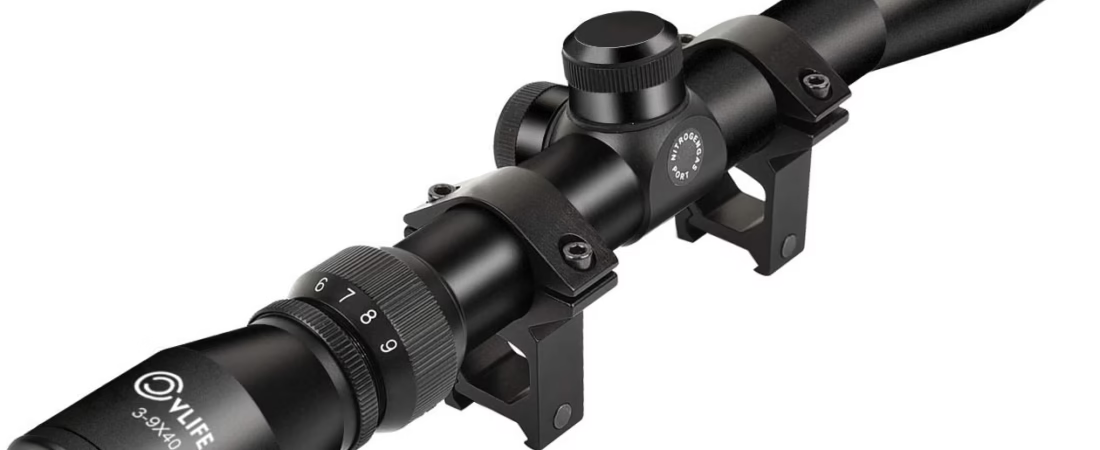
A riflescope is an optical instrument designed to make distant objects easier to view through magnification and a reticle. For people researching compact variable-power optics, the CVLIFE 3-9×40 Optics R4 Reticle Crosshair Scope is an example of a traditional 3-9x variable-magnification scope paired with a 40mm objective lens and a simple crosshair reticle.
The product is designed around a straightforward optical concept. At the lower 3x setting, the user receives a wider field of view that can make it easier to observe a larger area. Increasing the magnification toward 9x narrows the field of view while making distant objects appear larger through the optic. CVLIFE lists a 40mm objective lens, 3-9x magnification range, 3.5-inch eye relief, a 25-14-foot field of view at 100 yards, a 1-inch tube, and a weight of approximately 0.76 pounds for this version.
The scope also uses an R4-style crosshair reticle and includes mounting hardware. One important detail is that CVLIFE sells closely related versions with different mounting systems. The version associated with 20mm Picatinny-style mounts is different from the version supplied with 11mm dovetail mounts. Checking the rail on the intended equipment is therefore an important part of compatibility.
This article focuses on understanding the product as an optical accessory: what the specifications mean, how its components work together, what to consider when evaluating compatibility, and how it compares with other general categories of optics.
Because a riflescope can be used with equipment capable of launching projectiles, safe handling and compliance with applicable laws and manufacturer instructions should always take priority. This guide does not provide instructions for weapon operation or shooting techniques.
Understanding the CVLIFE 3-9×40 Configuration
The name “3-9×40” describes three important aspects of the optic.
The first number, 3x, represents the minimum magnification.
The second number, 9x, represents the maximum magnification.
The final number, 40, refers to the approximate diameter of the objective lens in millimeters.
This combination is common in traditional variable-power scopes because it provides a range between relatively wide viewing at low magnification and a more enlarged image at higher magnification.
At 3x, the image is less magnified and the field of view is wider.
At 9x, the image is more enlarged but the visible area becomes narrower.
CVLIFE lists the field of view at approximately 25 feet at 100 yards at 3x and approximately 14 feet at 100 yards at 9x for the relevant model.
The 40mm objective lens sits at the front of the scope and is responsible for gathering incoming light before it reaches the internal optical system.
A larger objective lens can provide more potential light-gathering capability, although image brightness is influenced by the entire optical design, coatings, exit pupil, lighting conditions, and the user’s eye.
Key Features
3-9x Variable Magnification
The variable 3-9x range is one of the most important characteristics of the scope.
Rather than providing only one fixed magnification, the user can change the magnification according to the viewing situation.
At the lower end, 3x provides a broader field of view.
At the higher end, 9x provides more visual enlargement.
This flexibility can also make the scope useful as an observation optic in appropriate settings.
Higher magnification does not automatically mean a better image. As magnification increases, hand movement, vibration, atmospheric effects, and optical imperfections can become more noticeable.
For that reason, understanding magnification as a range rather than simply focusing on the maximum number is useful when comparing scopes.
40mm Objective Lens
The scope uses a 40mm objective lens.
The objective is the large front lens that collects light.
The diameter affects the amount of light the optical system can potentially receive, although it should not be interpreted as a guarantee of image brightness.
Other elements matter as well, including lens coatings, glass quality, exit pupil, ambient lighting, and the design of the optical system.
The 40mm format also influences the overall physical dimensions of the scope.
A larger objective may require appropriate clearance from the mounting platform and surrounding equipment.
R4 Crosshair Reticle
The scope uses an R4 crosshair-style reticle.
A conventional crosshair is intentionally simple. Rather than using a complicated illuminated grid or multiple ranging marks, it provides a central reference within the field of view.
Simple reticles can be relatively easy to understand because there are fewer visual elements competing for attention.
For users who prefer straightforward optics rather than illuminated or highly graduated reticles, this type of design represents a traditional approach.
The exact visual appearance of a reticle should always be confirmed using the manufacturer’s current product information because related CVLIFE models can use different reticle configurations.
3.5-Inch Eye Relief
CVLIFE lists approximately 3.5 inches of eye relief for the relevant 3-9×40 version.
Eye relief refers to the distance between the rear optical surface and the position where the user’s eye can see the full intended image.
This is an important specification for comfort and safe optical viewing.
A suitable eye-relief arrangement allows the user to see the field of view without needing to place the eye directly against the eyepiece.
Users should follow the manufacturer’s safety instructions and maintain an appropriate viewing position.
1-Inch Tube
The scope uses a 1-inch, or approximately 25.4mm, main tube. CVLIFE lists a 1-inch tube diameter for this model.
Tube diameter matters when selecting compatible mounting rings.
Mounts designed for a different tube diameter should not simply be assumed to fit.
The mount and scope should be matched according to the manufacturer’s specifications.
Fully Multi-Coated Lenses
CVLIFE describes the scope as using fully multi-coated lenses and states that the coatings are intended to improve light transmission and contrast.
Lens coatings are important in optical systems because light passes through multiple glass surfaces.
Without appropriate coatings, reflections at those surfaces can reduce the amount of light reaching the image.
Multi-coating is therefore a useful optical design characteristic.
However, the term “fully multi-coated” should not be interpreted as guaranteeing a particular level of image quality under every condition. Optical performance depends on the complete system.
Scratch-Resistant Exterior Lens Coating
CVLIFE also describes a scratch-resistant coating intended to help protect the exterior lens surfaces from contaminants such as oil and dirt.
Even with protective coatings, optical lenses should be handled carefully.
Dust should not be aggressively rubbed across a lens surface because particles can potentially create scratches.
A proper lens-cleaning method is preferable to using ordinary paper or clothing.
Nitrogen-Filled Construction
CVLIFE states that the scope is sealed and nitrogen filled, describing it as fog and rain resistant.
Nitrogen filling is commonly used in optical equipment to reduce internal moisture and help prevent internal fogging caused by temperature changes.
It is important to distinguish this from unlimited waterproofing.
A sealed, nitrogen-filled optic may have improved resistance to environmental conditions, but users should still follow the manufacturer’s care instructions and avoid assuming that any scope can safely withstand prolonged water exposure.
Aluminum Construction
CVLIFE identifies the main scope tube as a machined-aluminum construction for this product family.
Aluminum is widely used in optical equipment because it can provide a useful combination of strength and relatively low weight.
The listed weight of approximately 0.76 pounds helps keep the optic relatively manageable compared with some larger high-magnification scopes.
Mounting Hardware
The product listing identifies included mounting hardware, but the exact mount configuration depends on the version.
CVLIFE lists one version with 20mm Picatinny-style mounts and another version with 11mm dovetail mounts.
This distinction is extremely important.
A scope may have the correct tube diameter but still be incompatible with the equipment’s rail.
Before installation, the mounting system should be identified rather than assuming that all 3-9×40 versions use the same rings.
How the Optical System Works
A scope can appear simple from the outside, but several optical components work together inside.
Objective Lens
The front 40mm lens gathers incoming light.
Internal Optical System
The collected light passes through internal lenses that enlarge and focus the image.
Magnification Mechanism
The magnification ring changes the optical configuration so that the image can be viewed at different levels of enlargement.
Reticle
The reticle provides a fixed reference within the viewing image.
Eyepiece
The rear portion of the scope presents the final image to the user’s eye.
These components need to work together for the image to appear clear.
An issue with one part of the optical system can affect the overall viewing experience.
How Magnification Affects the Viewing Experience
Magnification is one of the easiest specifications to understand incorrectly.
More magnification means a larger apparent image, but it also means a smaller field of view.
The CVLIFE 3-9×40 illustrates this relationship.
At 3x, the listed field of view is approximately 25 feet at 100 yards.
At 9x, it decreases to approximately 14 feet at 100 yards.
This means that changing magnification changes how much of the surrounding scene remains visible.
Lower magnification provides more context.
Higher magnification provides more enlargement.
Neither setting is inherently preferable for every situation.
Understanding Exit Pupil
Exit pupil is another useful optical specification.
CVLIFE lists an exit pupil range of approximately 5.1mm to 16.9mm for the relevant 3-9×40 scope.
The exit pupil is the diameter of the beam of light leaving the eyepiece.
It changes with magnification.
At lower magnification, the exit pupil is larger.
At higher magnification, it becomes smaller.
This matters because the human eye can only use a certain amount of incoming light depending on ambient conditions and the eye’s adaptation.
A larger exit pupil can make the viewing experience more forgiving in certain lighting conditions, while a smaller exit pupil can require more precise eye positioning.
Field of View and Why It Matters
Field of view describes how much of the scene can be seen through the scope at a particular distance.
For this scope, CVLIFE lists approximately 25 to 14 feet at 100 yards, depending on magnification.
A wider field of view can make it easier to observe a larger area.
A narrower field of view provides more visual enlargement but less surrounding context.
This is why variable magnification can be useful for general observation.
The user can select a lower magnification when broader context is useful and increase magnification when more enlargement is desired, subject to safe and lawful use.
Understanding the Adjustment Turrets
The scope includes elevation and windage adjustment turrets.
CVLIFE lists a click value of 1/4 inch at 100 yards for the relevant model.
These controls are part of the optical adjustment system.
Because this product is intended as an accessory for equipment capable of launching projectiles, adjustments should be made only in accordance with the manufacturer’s instructions and applicable safety procedures.
The important point from a product-understanding perspective is that the turrets allow the optical system to be adjusted rather than being permanently fixed in one configuration.
The manufacturer’s manual should be consulted for any installation or adjustment procedure.
CVLIFE maintains a dedicated manuals section for its scope products, including the FoxSpook 3-9×40 family.
Mount Compatibility Is an Important Consideration
One of the easiest mistakes when shopping for a scope is assuming that a similar-looking mount will fit.
The scope itself uses a 1-inch tube.
That does not determine the type of rail mount needed.
The mounting system is a separate compatibility issue.
CVLIFE lists a 20mm Picatinny-style mounting version and a separate 11mm dovetail version.
The 11mm version is described for narrow dovetail rails, while the 20mm version is intended for compatible Picatinny-style rails.
Before selecting a version, identify the rail type on the intended equipment.
Do not force a mount into a rail simply because the dimensions appear close.
Proper mechanical compatibility matters for safety, stability, and preventing damage to the equipment.
How It Can Be Used
The CVLIFE 3-9×40 is primarily an optical accessory intended for compatible equipment.
At a general level, the scope can be used for magnified observation where the mounting platform and application are appropriate.
Potential categories include:
- Recreational optical observation
- Compatible airsoft equipment
- Appropriate rimfire platforms
- Other equipment specifically supported by the manufacturer
CVLIFE’s current documentation identifies different compatibility information for related versions, including airsoft and several rimfire or pellet platforms for the 11mm configuration.
Compatibility should always be checked against the exact product version, mounting rail, and manufacturer’s documentation.
The scope should not be treated as universally compatible with every rifle or other platform simply because it uses a 1-inch tube.
Who It May Be Suitable For
Users Looking for Variable Magnification
People interested in a traditional variable-power optical system may appreciate the flexibility of a 3-9x configuration.
Users Who Prefer a Simple Reticle
The R4 crosshair design provides a comparatively straightforward viewing reference.
Someone who does not need an illuminated reticle or complex ranging pattern may prefer this type of visual layout.
Users With Compatible 11mm or 20mm Rails
The appropriate version may be relevant to users whose equipment already has a compatible rail.
The exact mount type should be confirmed before installation.
Recreational Optics Users
For people interested in optical observation and compatible recreational equipment, a traditional 3-9×40 format can provide a familiar combination of moderate magnification and a relatively large objective lens.
Users Who Prefer Traditional Scope Controls
The design uses a conventional magnification ring and adjustment turrets rather than relying on electronic controls.
That can appeal to users who prefer mechanical optical equipment.
Important Things to Consider
Confirm the Exact Mount Version
This is perhaps the most important compatibility consideration.
CVLIFE offers related versions with different mounts.
Check whether the intended rail is 11mm dovetail or 20mm Picatinny-style before selecting the corresponding version.
Check Tube Diameter Separately
The scope uses a 1-inch tube.
Mount rings must match the tube diameter.
A compatible rail alone does not guarantee compatible rings.
Eye Relief Matters
The listed eye relief is approximately 3.5 inches.
Users should understand the importance of maintaining appropriate eye distance and following the manufacturer’s safety instructions.
Magnification Changes Field of View
Moving from 3x to 9x reduces the visible field.
This is normal behavior for variable-power optics.
Higher Magnification Can Reveal Atmospheric Effects
At greater magnification, haze, heat shimmer, dust, and other atmospheric conditions can become more noticeable.
This is a general characteristic of magnified optics rather than a defect specific to one scope.
Optical Quality Is More Than Magnification
A 9x maximum magnification number does not tell the entire story.
Lens coatings, glass quality, alignment, focusing, eye relief, field of view, and environmental conditions all contribute to the image.
Weather Resistance Has Limits
The manufacturer describes this scope as sealed and nitrogen filled and states that it is fog and rain proof.
That does not mean the product should be intentionally submerged or exposed to conditions beyond its specifications.
Maintain the Lenses Carefully
Optical surfaces should be treated as precision components.
Dust, fingerprints, moisture, and abrasive cleaning materials can affect clarity or potentially damage coatings.
Follow the Manufacturer’s Manual
CVLIFE provides manuals for its scope products.
The manual is particularly important for installation, maintenance, adjustment, and safe handling.
Comparison of General Optics Categories
Fixed-Power Scope vs. 3-9x Variable Scope
A fixed-power scope provides one magnification level.
Its design can be simpler because there is no variable magnification mechanism.
A 3-9x scope provides a range of magnifications.
That flexibility can be useful for people who want to change the apparent size of the viewed scene.
The tradeoff is additional mechanical complexity and the need to manage the magnification setting.
3-9x Scope vs. Higher-Magnification Scope
A 3-9x scope occupies a moderate magnification category.
Higher-magnification optics can provide more enlargement but generally have narrower fields of view at their upper settings.
They may also be larger and heavier.
A 3-9x configuration can therefore represent a more moderate approach to variable magnification.
Traditional Crosshair vs. Illuminated Reticle
A traditional black crosshair does not require an electronic illumination system.
An illuminated reticle adds lighting to the reticle itself.
Illumination can change visibility under certain lighting conditions, but it also introduces additional components and usually requires a power source.
The R4 crosshair design follows the simpler traditional approach.
40mm Objective vs. Smaller Objective
A 40mm objective is larger than many compact optics.
A larger objective can provide more potential light-gathering capability, but it may also increase the overall size and mounting requirements.
Smaller objectives can produce more compact optics.
The choice involves balancing optical design, size, weight, and intended use.
Optical Scope vs. Digital Sight
Traditional optical scopes use lenses to create the viewed image.
Digital sights use electronic sensors and displays.
Digital systems can support features such as electronic reticles, recording, digital zoom, and other software-driven functions.
The CVLIFE 3-9×40 follows the traditional optical approach.
Caring for the Scope
Keep the Exterior Clean
A soft, appropriate cloth can be used for general exterior cleaning.
Avoid abrasive materials that could damage surfaces.
Protect the Lenses
Lens covers can help reduce exposure to dust and debris when the optic is not being used.
The package information for the CVLIFE 3-9×40 includes lens covers.
Avoid Excessive Moisture
Even when an optic has environmental protection, unnecessary exposure to water should be avoided.
If the scope becomes wet, follow the manufacturer’s recommended drying and storage procedure.
Avoid Extreme Temperature Changes
Moving optical equipment rapidly between very different temperatures can produce external condensation.
Allowing the scope to acclimate naturally can reduce temporary fogging.
Inspect Mounting Hardware
The scope and its mounting components should be inspected regularly for signs of damage or looseness.
Any damaged component should be addressed before the equipment is used.
Optical Terminology Worth Knowing
Understanding a few common terms can make it easier to compare scopes.
Magnification: How much larger the viewed image appears compared with the unaided view.
Objective diameter: The diameter of the front lens.
Eye relief: The distance from the eyepiece at which the full image can be viewed.
Field of view: The width of the visible scene at a specified distance.
Exit pupil: The apparent diameter of the light beam exiting the eyepiece.
Reticle: The visual reference pattern seen through the optic.
Tube diameter: The diameter of the main body where mounting rings attach.
MOA: Minute of angle, an angular measurement commonly used to describe adjustment increments in certain optical systems.
These specifications describe different aspects of an optic and should not be treated as interchangeable.
Frequently Asked Questions
What does 3-9×40 mean?
It means the scope has variable magnification from 3x to 9x and a 40mm objective lens.
What reticle does the CVLIFE scope use?
The product is identified as an R4 reticle crosshair scope. CVLIFE describes the design as a traditional crosshair configuration.
What is the objective lens diameter?
The objective lens is 40mm.
What is the tube diameter?
The scope uses a 1-inch, approximately 25.4mm, main tube.
How much does it weigh?
CVLIFE lists the scope at approximately 0.76 pounds, or around 345 grams, for the relevant version.
What is the field of view?
CVLIFE lists approximately 25 feet to 14 feet at 100 yards, depending on magnification.
How much eye relief does it have?
The relevant CVLIFE specification lists approximately 3.5 inches of eye relief.
Does the scope have illuminated reticles?
The standard R4 version is a non-illuminated crosshair design. CVLIFE separately lists illuminated models in its product range.
Does the scope have night vision?
No. CVLIFE’s product information identifies the standard model as not having night vision.
Is the scope waterproof?
CVLIFE describes the scope as sealed and nitrogen filled and states that it is fog and rain proof.
This should not be interpreted as unlimited waterproofing or permission to submerge the optic.
What type of mount does it use?
The answer depends on the exact version. CVLIFE offers a version with 20mm Picatinny-style mounts and another with 11mm dovetail mounts.
Are the included mounts compatible with every rail?
No.
The included mounts are intended for their specified rail type. The rail on the intended equipment should be identified before purchase or installation.
Can it fit an 11mm dovetail rail?
CVLIFE lists a specific version with 11mm dovetail mounts.
The exact product variation should be checked because the 20mm version is designed for a different mounting system.
Can it fit a 20mm Picatinny-style rail?
CVLIFE lists a separate version supplied with 20mm mounts for compatible rails.
Does it have adjustable windage and elevation?
Yes. The product uses adjustment turrets, and CVLIFE lists a 1/4-inch adjustment value at 100 yards.
Any actual adjustment or installation should follow the manufacturer’s instructions and appropriate safety procedures.
What is the exit pupil?
CVLIFE lists an exit pupil range of approximately 5.1mm to 16.9mm for the relevant 3-9×40 model.
Does it come with lens covers?
Yes. CVLIFE’s package information lists lens covers among the included components.
Does it come with an Allen key?
Yes. The listed package contents include an Allen key along with the scope and mounting hardware.
Is this an adjustable-objective model?
The standard 3-9×40 R4 model and the 3-9×40 AO model are separate products. The AO version includes adjustable objective functionality, while the standard version should not be assumed to have it.
What is the difference between an ordinary 3-9×40 and a 3-9×40 AO?
An AO, or adjustable-objective, model provides an additional objective-side adjustment mechanism for parallax-related optical adjustment. The standard model does not have the same adjustable-objective configuration. CVLIFE lists these as separate models.
Is the scope suitable for airsoft?
CVLIFE lists airsoft among the compatible applications for the 11mm version.
Users should confirm that the exact version and mounting system match their equipment.
Is the scope suitable for rimfire equipment?
CVLIFE’s current information for the 11mm version identifies several rimfire and pellet-related compatible platforms, including .22 and .17 configurations.
Compatibility should always be checked against the exact platform and manufacturer’s specifications.
Is a larger magnification always better?
No.
Higher magnification produces a larger apparent image but reduces field of view and can make movement and atmospheric effects more noticeable.
Why does the image become harder to keep steady at higher magnification?
Magnification enlarges not only the target but also apparent movement. This is a normal characteristic of magnified optics.
How should the lenses be cleaned?
Use appropriate optical-cleaning materials and avoid abrasive surfaces. Follow the manufacturer’s care recommendations.
Where can the manufacturer’s instructions be found?
CVLIFE maintains a scope-manual section containing documentation for its scope products.
Should I assume every CVLIFE 3-9×40 scope uses the same mounts?
No.
CVLIFE lists multiple versions with different mounting systems, including 11mm dovetail and 20mm Picatinny-style configurations.
Conclusion
The CVLIFE 3-9×40 Optics R4 Reticle Crosshair Scope represents a traditional variable-power optical design built around a 3-9x magnification range, 40mm objective lens, simple crosshair reticle, 1-inch tube, and approximately 3.5 inches of eye relief. CVLIFE lists a field of view of approximately 25 to 14 feet at 100 yards and a weight of around 0.76 pounds for the relevant configuration.
Its appeal as an optical category comes from its straightforward design. The variable magnification allows the user to change the apparent size of the viewed scene, while the 40mm objective provides a relatively substantial front lens without moving into the much larger dimensions associated with some high-magnification optics.
The R4 crosshair also follows a traditional approach. Instead of relying on electronic illumination or a complicated reticle pattern, it provides a simple visual reference.
Another important feature is the availability of different mounting configurations. CVLIFE lists versions with 11mm dovetail mounts and 20mm Picatinny-style mounts, making rail compatibility an essential consideration when selecting the appropriate package.
The scope is also described by CVLIFE as sealed and nitrogen filled, with fog and rain resistance, while fully multi-coated lenses are intended to support light transmission and contrast.
When comparing this type of optic with other scopes, it is useful to look beyond maximum magnification. Objective diameter, field of view, eye relief, exit pupil, reticle design, tube diameter, mounting system, optical coatings, and physical size all contribute to how an optic fits a particular application.
For any equipment capable of launching projectiles, compatibility and safe handling are especially important. The scope, mount, and host platform should be treated as separate components that need to be properly matched, and manufacturer instructions and applicable laws should always be followed.
For readers researching the specifications and current package configuration of this scope,