Introduction
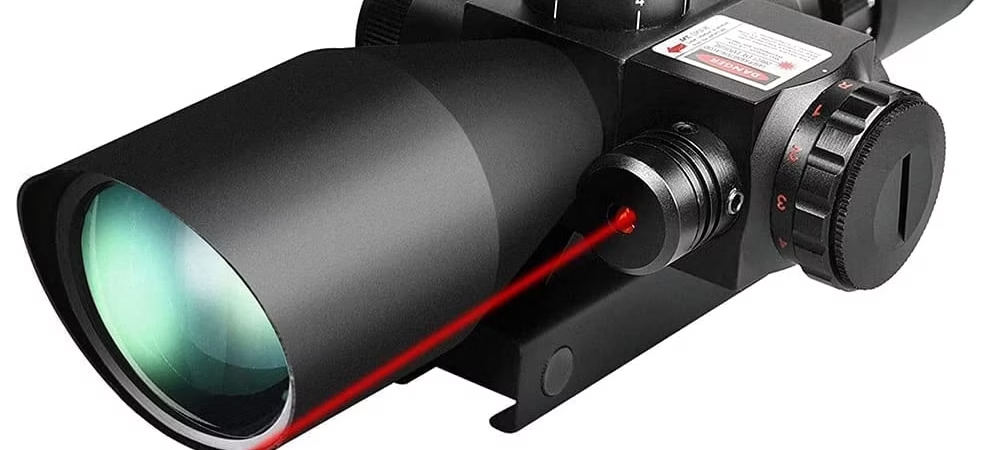
A riflescope combines optical magnification with a reticle to provide a more detailed view of distant objects through compatible equipment. For users researching variable-power optics, the CVLIFE 2.5-10x40e Red & Green Illuminated Scope represents a traditional scope configuration with several additional features, including dual-color reticle illumination, a Mil-dot reticle, a 40mm objective lens, and an integrated laser accessory.
The scope is designed around a 2.5x to 10x variable magnification range. At the lower end, the wider viewing perspective can make it easier to observe a larger portion of the scene. At higher magnification, distant subjects appear larger, although the field of view becomes narrower and movement becomes more noticeable.
CVLIFE’s current product information lists a 40mm objective lens, multi-coated green lenses, red and green illumination with five brightness levels for each color, a Mil-dot reticle, approximately 3 to 4 inches of eye relief depending on magnification, and a 1/4-inch click value at 100 yards. The company also lists a 2mW Class IIIA laser and a 20mm mounting configuration for compatible Picatinny-style rails.
The combination of magnification, illuminated reticle, and laser makes this product different from a basic fixed-power optical scope. At the same time, additional features introduce additional considerations involving battery use, optical adjustment, rail compatibility, laser safety, and the distinction between an optical reticle and a projected laser point.
This guide focuses on understanding the product and its technology rather than treating it as a direct review. It explains what the major specifications mean, how the optical system fits into the broader category of sporting optics, who may find this type of scope relevant, and what should be considered before selecting or using one.
For any firearm-related application, the equipment should be handled only in accordance with applicable laws, manufacturer instructions, range rules, and established firearm-safety practices. For airsoft or other recreational platforms, users should follow the relevant field rules and protective-equipment requirements.
Understanding the 2.5-10×40 Configuration
The product name provides three useful pieces of information: 2.5x, 10x, and 40mm.
Each specification describes a different characteristic of the optical system.
What Does 2.5-10x Mean?
The first two numbers indicate variable magnification.
The scope can operate from a lower magnification of approximately 2.5x through a maximum of approximately 10x.
At 2.5x, the image is enlarged relatively modestly. This allows more of the surrounding scene to remain visible.
At 10x, the image appears substantially larger, but the field of view becomes narrower.
This relationship is important when understanding variable-power optics.
Higher magnification does not automatically mean better overall optical performance. Increasing magnification also makes small movements more apparent, reduces the visible area, and can make atmospheric effects such as haze or heat shimmer more noticeable.
A variable-power design gives the user the ability to choose a magnification level appropriate to the viewing situation.
What Does 40 Mean?
The 40 refers to the approximate diameter of the objective lens in millimeters.
The objective is the large front lens of the scope.
A larger objective can collect more incoming light than a smaller objective under otherwise comparable conditions.
However, objective diameter should not be treated as an independent measure of image quality.
Lens coatings, optical glass, internal alignment, magnification, exit pupil, ambient light, and atmospheric conditions all affect the final image.
A 40mm objective also affects the physical size of the scope, so users need to consider clearance and mounting requirements when evaluating compatibility.
Key Features
Variable 2.5-10x Magnification
The variable magnification system is one of the defining features of this scope.
A lower magnification setting can provide a broader field of view, while higher magnification provides greater enlargement.
CVLIFE lists a field of view of approximately 34.86 feet at 100 yards at 2.5x and approximately 11.53 feet at 100 yards at 10x for the 2.5-10x40e version.
This illustrates the basic tradeoff.
At the lower setting, more of the scene is visible.
At the higher setting, the visible area becomes smaller.
This is normal for variable-power optical systems.
40mm Objective Lens
The 40mm objective lens provides the front aperture through which light enters the scope.
A relatively large objective can be useful in conditions where available light is reduced, although actual image brightness depends on the complete optical design.
The objective also influences the physical dimensions of the scope.
A larger objective can require more clearance between the scope and the mounting platform.
Multi-Coated Green Lenses
CVLIFE describes the scope as using multi-coated green lenses and states that the design is intended to improve light transmission and image clarity.
Lens coatings are an important part of optical design because every glass surface can reflect a portion of incoming light.
Appropriate coatings can reduce unwanted reflections and improve the amount of useful light passing through the system.
The term “multi-coated,” however, does not guarantee identical optical performance under every condition.
The quality of the glass, coating process, optical alignment, and overall construction remain important.
Mil-Dot Reticle
The scope uses a Mil-dot reticle.
A Mil-dot reticle contains a central aiming reference surrounded by additional reference points.
Mil-based reticles are used in various optical applications because the pattern can provide additional visual references beyond a simple crosshair.
For general product understanding, it is useful to distinguish between the reticle itself and the illumination system.
The Mil-dot pattern is the optical reference.
The red or green illumination changes how that reference appears to the user.
Red and Green Illumination
The scope provides both red and green illuminated reticle options.
CVLIFE lists five brightness levels for red and five brightness levels for green.
Different colors can provide different levels of contrast depending on the background and lighting environment.
Individual eyesight also matters.
A setting that appears comfortable to one user may be too bright or too dim for another.
The purpose of illumination is primarily to make the reticle easier to see.
It does not increase the optical resolution of the scope.
Eye Relief
CVLIFE lists approximately 4 inches of eye relief at 2.5x and approximately 3 inches at 10x for the current 2.5-10x40e specification.
Eye relief describes the distance between the eyepiece and the position from which the user can see the intended field of view.
This is an important optical characteristic.
Users should follow the manufacturer’s instructions concerning safe viewing position and should not place the eye unnecessarily close to the eyepiece.
Exit Pupil
CVLIFE lists an exit-pupil range of approximately 0.52 inches to 0.17 inches for the 2.5-10x40e specification.
The exit pupil becomes smaller as magnification increases.
A larger exit pupil can make eye positioning more forgiving, while a smaller exit pupil can require more precise alignment between the user’s eye and the eyepiece.
This is one reason why the viewing experience can change noticeably when moving from the lower to the higher magnification settings.
1/4-Inch Click Value
The manufacturer’s current specifications list a 1/4-inch click value at 100 yards.
This describes the increment associated with the scope’s adjustment system.
Because the product is intended for firearm-related and projectile-launching applications, users should rely on the manufacturer’s documentation and qualified supervision for any installation or adjustment procedure.
The specification is useful for understanding the design of the optic, but this article does not provide instructions for zeroing or configuring a weapon.
Integrated Laser
The product incorporates a laser accessory into the scope assembly.
CVLIFE’s current specifications identify the laser as a 2mW Class IIIA unit with a 650nm wavelength.
The laser is fundamentally different from the illuminated reticle.
The reticle exists within the optical viewing system.
The laser projects a point of light into the external environment.
This distinction is important for both understanding the product and using it responsibly.
Understanding the Illuminated Reticle
A traditional non-illuminated reticle relies on contrast between the reticle and the viewed background.
That can work well under many conditions, but there are situations where the reticle can become difficult to distinguish.
Illumination adds a visible color to the reticle.
The CVLIFE scope provides red and green options with multiple brightness settings.
Why Use Red?
Red illumination can provide useful contrast in a variety of environments.
It can also be adjusted to different brightness levels.
Why Use Green?
Green can appear more prominent against certain backgrounds.
The most useful color depends on the environment and individual visual perception.
Brightness Matters
More illumination is not always better.
If the reticle is too bright, it can become distracting or reduce the user’s ability to distinguish the surrounding image.
If it is too dim, it may disappear into the background.
The multiple brightness settings provide flexibility without changing the optical magnification itself.
Understanding the Mil-Dot Reticle
The Mil-dot pattern is more complex than a simple crosshair.
The dots provide additional reference points across the reticle.
In professional and sporting optics, mil-based reticles can be used as angular references.
However, the exact interpretation of a mil-dot pattern depends on the optical design, magnification, reticle placement, and the user’s understanding of the system.
It is therefore important not to assume that every dot automatically represents a particular physical distance.
For general observation, the additional references can simply provide visual structure within the sight picture.
For any technical application involving projectile equipment, users should rely on the manufacturer’s documentation and appropriate training rather than informal assumptions about reticle measurements.
How the Laser Differs From the Reticle
The integrated laser is one of the most noticeable differences between this product and a conventional illuminated scope.
The Reticle
The reticle is visible only through the scope.
It remains inside the optical image.
The Laser
The laser projects a beam into the external environment.
The resulting point appears on a surface in front of the user.
These are two different technologies.
The presence of both does not mean that they should always be used simultaneously.
The appropriate use depends on the application, environment, rules, and safety requirements.
Laser Safety
The laser component requires particular care.
CVLIFE lists the laser as Class IIIA and 2mW.
Regardless of the stated power classification, users should treat the laser as a potentially hazardous optical source.
Never Direct It Toward Eyes
A laser should never be intentionally pointed at a person’s eyes.
Reflections from shiny surfaces can also redirect laser light.
Avoid Aircraft
Lasers should never be directed toward aircraft.
Users should also be aware that laser use around aircraft and other vehicles can be subject to serious legal restrictions.
Follow Local Regulations
Rules concerning laser accessories can differ between jurisdictions.
Some recreational facilities may prohibit laser devices entirely.
Consider Airsoft Field Rules
If used with airsoft equipment, the field operator’s rules should be followed.
Protective eyewear remains essential in airsoft environments regardless of whether an optical accessory is installed.
How It Can Be Used
General Sporting Optics
At a general level, the scope is designed as an optical accessory for compatible equipment.
Its variable magnification allows the user to observe a scene at different levels of enlargement.
Its illuminated reticle provides an additional visual reference.
The laser provides a separate projected reference.
Any firearm-related application should remain within applicable laws and established safety practices.
Airsoft
CVLIFE lists airsoft among the product’s intended sport categories.
In airsoft, a magnified optic can provide a different viewing experience from a simple red-dot sight.
However, the value of magnification depends on the field.
On a compact field with short sightlines, high magnification may provide little practical benefit.
On larger outdoor fields, magnification can provide additional observation capability.
Laser use should always be subject to the specific field’s rules.
Outdoor Observation
The scope can also be viewed as a magnified optical instrument in appropriate settings.
The variable magnification can make distant scenery easier to examine.
Users should not assume that the presence of a laser makes the scope appropriate for every outdoor activity.
The laser should be treated as a separate safety-sensitive component.
Who It May Be Suitable For
Airsoft Players With Compatible Rails
The product may be relevant to airsoft players whose equipment has a compatible 20mm mounting interface.
The exact rail dimensions and mount configuration should be confirmed before use.
Recreational Optics Users
People interested in variable magnification and illuminated reticles may find the product category relevant to their interests.
Users Who Prefer Adjustable Illumination
The ability to choose between red and green illumination and multiple brightness levels provides more flexibility than a permanently non-illuminated reticle.
Users Interested in Multi-Function Accessories
The integrated laser provides another feature in addition to the primary optical system.
However, users should consider whether they actually need all of the functions because each additional feature introduces more controls and power requirements.
Important Things to Consider
Confirm the Rail Type
CVLIFE identifies the 20mm mount as suitable for compatible Picatinny-style rails.
The host equipment’s rail should be verified before selecting the product.
A mounting accessory should never be forced onto an incompatible rail.
Check the Complete Package Configuration
CVLIFE lists related 2.5-10×40 models with different mounting configurations, including 20mm Picatinny and 11mm dovetail versions.
This means buyers should pay attention to the exact variation rather than assuming every product carrying the 2.5-10×40 name has the same mount.
Consider the Overall Size
CVLIFE lists the FoxSpook 2.5-10x40e at approximately 20.5 ounces and approximately 8.5 inches in length.
A scope of this size adds noticeable weight and length compared with a compact red-dot sight.
This may matter for users who carry equipment over long distances.
Consider Eye Relief
The stated eye-relief range is approximately 3 to 4 inches depending on magnification.
Users should follow the manufacturer’s instructions and maintain an appropriate viewing position.
Higher Magnification Narrows the View
At 2.5x, the manufacturer lists a field of view of approximately 34.86 feet at 100 yards.
At 10x, that decreases to approximately 11.53 feet.
This is a normal characteristic of variable-power optics.
Atmospheric Conditions Matter
Haze, humidity, dust, smoke, rain, and heat shimmer can affect distant viewing.
Higher magnification can make those effects more noticeable.
Battery Requirements
The illuminated reticle and laser require batteries.
CVLIFE’s package information lists a CR2032 battery for the scope illumination and three LR1130 batteries for the laser in the relevant configuration.
Battery specifications and package contents can change between product versions, so users should confirm the current documentation.
Weather Resistance Has Limits
CVLIFE describes the scope as O-ring sealed and nitrogen purged and markets it as waterproof and fogproof.
These descriptions should still be interpreted according to the manufacturer’s specifications.
Water-resistant construction does not mean that any optical device should be deliberately submerged or exposed to conditions beyond its stated limits.
Optical Quality Is More Than Magnification
The maximum 10x figure does not independently determine optical quality.
Lens coatings, glass, focus, alignment, light transmission, field of view, exit pupil, and environmental conditions all matter.
Comparison of General Categories
Variable Scope vs. Fixed-Power Scope
A fixed-power scope remains at one magnification.
A variable scope such as the 2.5-10×40 configuration allows the magnification to change.
Variable magnification provides flexibility but introduces additional mechanical components.
A fixed scope can be simpler because there is no magnification adjustment mechanism.
Variable Scope vs. Red-Dot Sight
A red-dot sight normally provides little or no optical magnification.
Its primary function is to provide a simple illuminated reference.
The CVLIFE scope provides both magnification and an illuminated Mil-dot reticle.
The two categories therefore serve different optical purposes.
Illuminated Scope vs. Non-Illuminated Scope
An illuminated scope can make the reticle easier to distinguish in certain lighting conditions.
A non-illuminated scope relies entirely on contrast between the reticle and background.
The illuminated design requires batteries, while a conventional non-illuminated reticle does not.
Integrated Laser vs. Separate Laser Accessory
An integrated laser keeps the laser physically attached to the optical assembly.
A separate laser accessory can provide more flexibility in positioning but requires an additional mounting interface and component.
The integrated configuration can simplify the overall equipment arrangement, while the separate approach can provide more modularity.
40mm Objective vs. Smaller Objective
A 40mm objective provides a relatively substantial front lens.
A smaller objective can reduce overall size and weight.
The larger objective may provide more light-gathering potential, while the smaller objective can make a setup more compact.
Understanding Optical Brightness
It is easy to assume that a larger objective automatically creates a bright image.
The reality is more complicated.
A useful optical relationship is the exit pupil.
For a basic 40mm objective:
- At 2.5x, the theoretical exit pupil is approximately 16mm.
- At 10x, the theoretical exit pupil is approximately 4mm.
CVLIFE lists an exit-pupil range of approximately 16mm to 4mm for the related 2.5-10×40 configuration.
The actual viewing experience depends on the user’s eye, ambient lighting, optical transmission, and other factors.
The large exit pupil at lower magnification can make eye positioning relatively forgiving.
At 10x, the smaller exit pupil requires more precise eye alignment.
Understanding Field of View
Field of view describes the width of the scene visible through the scope at a particular distance.
The manufacturer’s current 2.5-10x40e specification lists approximately:
- 34.86 feet at 100 yards at 2.5x
- 11.53 feet at 100 yards at 10x
The difference is significant.
At the lower setting, the user can see more of the surrounding scene.
At the higher setting, the subject appears larger but the visible area becomes smaller.
This is why variable magnification can be useful for different viewing situations.
Understanding the Objective Lens
The 40mm objective is the large front lens.
Its primary optical function is collecting incoming light.
A larger objective can be beneficial under reduced-light conditions, but there is always a physical tradeoff.
Larger objectives increase:
- Size
- Weight
- Mounting clearance requirements
Smaller objectives can reduce the overall footprint.
The appropriate objective size therefore depends on the intended application.
Maintaining the Scope
Keep the Optics Clean
Fingerprints, dust, and moisture can reduce contrast.
Use appropriate optical-cleaning materials rather than abrasive household cloths.
Protect the Lenses
CVLIFE lists a lens cover among the package contents for the relevant configuration.
Keeping the lenses covered when the scope is not being used can help reduce unnecessary exposure to dust and debris.
Protect the Batteries
Electronic accessories should be stored according to the manufacturer’s battery recommendations.
For long periods of storage, follow the instructions concerning battery removal or replacement.
Inspect the Mounting Hardware
Mounting components should be checked for damage before use.
Do not use damaged rings, mounts, or other hardware.
Protect Against Excessive Moisture
Although CVLIFE describes the scope as waterproof and fogproof, users should still follow the manufacturer’s environmental limitations.
Understanding the Integrated Laser
The laser deserves separate consideration because it changes the product from a purely optical scope into a combined optical and electronic accessory.
CVLIFE lists a 2mW Class IIIA laser at 650nm for the FoxSpook 2.5-10x40e configuration.
A projected laser point can be visually prominent under appropriate conditions.
However, its visibility depends on:
- Ambient lighting
- Target surface
- Distance
- Atmospheric conditions
- Beam alignment
- Environmental background
A laser should never be treated as a substitute for safe target identification or proper equipment handling.
Safety Considerations
Because this product is marketed for firearm and airsoft applications, safety should be considered an essential part of the product discussion.
Firearm Safety
Any firearm should be treated as loaded until it has been safely verified otherwise.
Keep the muzzle pointed in a safe direction and follow the safety rules applicable to the firearm and range.
Protective Equipment
Appropriate eye and hearing protection should be used where required.
Airsoft users should follow field-specific protective equipment requirements.
Laser Safety
Never direct the laser toward a person’s eyes.
Never aim a laser at an aircraft.
Avoid unsafe reflections and follow applicable regulations.
Follow Range Rules
Shooting ranges can have detailed rules concerning optics, lasers, equipment configuration, and safe handling.
Those rules should always take priority.
Frequently Asked Questions
What is the magnification range?
The CVLIFE scope has a 2.5x to 10x magnification range.
What is the objective lens diameter?
The objective lens is 40mm.
Does it have an illuminated reticle?
Yes. The scope provides illuminated red and green reticle options.
How many illumination levels does it have?
CVLIFE lists five brightness levels for red and five for green.
What type of reticle does it use?
The scope uses a Mil-dot reticle.
Does it include a laser?
Yes. The FoxSpook 2.5-10x40e configuration includes an integrated laser. CVLIFE lists a 2mW Class IIIA laser at 650nm.
Does the scope have night vision?
No. CVLIFE’s product information identifies the scope as not having night vision.
Illuminated reticles should not be confused with night-vision technology.
What type of mount does it use?
The requested configuration is supplied with a 20mm mount intended for compatible Picatinny-style rails.
Does CVLIFE make different mounting versions?
Yes. CVLIFE currently lists related 2.5-10×40 configurations with both 20mm Picatinny and 11mm dovetail mounting options.
What is the field of view?
For the 2.5-10x40e configuration, CVLIFE lists approximately 34.86 feet at 100 yards at 2.5x and 11.53 feet at 100 yards at 10x.
What is the eye relief?
CVLIFE lists approximately 4 inches at 2.5x and 3 inches at 10x for the 2.5-10x40e model.
What is the exit pupil?
CVLIFE lists an exit-pupil range of approximately 0.52 inches to 0.17 inches for the 2.5-10x40e specification.
What is the tube diameter?
CVLIFE lists the tube diameter at approximately 1.57 inches for the FoxSpook 2.5-10x40e specification.
How much does it weigh?
CVLIFE lists the net weight at approximately 20.5 ounces.
Is it waterproof?
CVLIFE describes the scope as O-ring sealed and nitrogen purged and markets it as waterproof and fogproof.
Users should still follow the manufacturer’s stated environmental limitations.
Is it shockproof?
CVLIFE describes the one-piece construction as shock resistant and states that the scope is designed to withstand substantial shock and vibration.
Actual durability depends on the equipment and conditions involved.
What batteries does it use?
CVLIFE’s package information lists a CR2032 battery for the scope illumination and three LR1130 batteries for the laser in the relevant configuration.
Package contents can vary by version, so users should confirm the current listing.
Does the package include lens covers?
CVLIFE lists a lens cover among the included components.
Does it include mounting hardware?
The 20mm configuration includes compatible mounting hardware according to CVLIFE’s product information.
Does it work with every 20mm rail?
Not necessarily.
Users should verify the exact rail interface and mounting dimensions of the host equipment.
Can it be used for airsoft?
CVLIFE lists airsoft among the product’s intended sport categories.
Airsoft field rules should be checked before using the laser or other accessories.
Can it be used for hunting?
The product is marketed as a hunting scope, but hunting laws, seasons, licensing requirements, and equipment restrictions vary by jurisdiction.
Users must verify the applicable rules before using any hunting-related equipment.
Does red or green illumination make the scope a night-vision optic?
No.
Reticle illumination simply makes the reticle visible in a selected color. Night vision is a separate technology involving specialized sensors or image intensification.
Does higher magnification automatically provide a clearer image?
No.
Higher magnification enlarges the image but can also make atmospheric effects, hand movement, and optical limitations more noticeable.
Why is the image less stable at 10x?
Magnification enlarges apparent movement as well as the viewed subject.
This is a normal characteristic of magnified optical systems.
Why is the field of view smaller at 10x?
Higher magnification shows a smaller portion of the surrounding scene.
This is the normal relationship between magnification and field of view.
What does the 1/4-inch click specification mean?
It describes the increment associated with the scope’s adjustment system at 100 yards.
Any installation or adjustment involving firearm equipment should follow the manufacturer’s instructions and appropriate safety procedures.
How should the lenses be cleaned?
Use appropriate optical-cleaning materials and avoid abrasive surfaces. Follow the manufacturer’s maintenance guidance.
Should the laser be pointed at a person?
No.
A laser should never be intentionally directed into someone’s eyes or used irresponsibly around people.
Can the laser be pointed at aircraft?
No.
Lasers should never be directed toward aircraft, and applicable laws concerning laser devices should always be followed.
Is this scope suitable for beginners?
The optical concepts are relatively straightforward, but firearm-related use requires appropriate safety knowledge and training.
Airsoft users should follow the safety requirements of their field.
What should I check before buying the scope?
Check the exact magnification range, objective diameter, reticle type, mounting interface, rail compatibility, battery requirements, physical dimensions, and whether the integrated laser is permitted for your intended application.
Conclusion
The CVLIFE 2.5-10x40e Red & Green Illuminated Scope combines several features within a traditional variable-power optical design.
The 2.5x to 10x magnification range provides flexibility between a broader viewing perspective and greater image enlargement. The 40mm objective provides the front aperture for collecting light, while the Mil-dot reticle offers a structured optical reference. CVLIFE also provides red and green illumination with five brightness levels for each color.
The integrated laser adds another layer of functionality, but it should be considered separately from the optical reticle. The laser projects light into the external environment and therefore requires additional attention to eye safety, aircraft safety, local regulations, and recreational-field rules. CVLIFE identifies the laser as a 2mW Class IIIA, 650nm unit for this configuration.
The mounting system is another important part of the product. The requested version is associated with a 20mm mounting configuration for compatible Picatinny-style rails, while CVLIFE also lists related versions using different mounting systems.
Optical performance should also be considered in context. A 10x maximum magnification does not automatically mean that every distant subject will appear sharply detailed. Field of view becomes narrower as magnification increases, movement becomes more visible, and atmospheric conditions can have a greater effect on distant observation.
The multi-coated green lenses, variable magnification, illuminated reticle, and relatively substantial 40mm objective give the scope a configuration that combines several common features found in recreational sporting optics. Whether those features are useful depends on the user’s equipment, environment, intended activity, and preferences.
For anyone researching this type of scope, compatibility and responsible use are as important as the optical specifications. The rail should be verified before installation, the manufacturer’s instructions should be followed, and any firearm-related use should comply with applicable laws and established safety practices.
For airsoft users, field-specific regulations should also be checked, particularly regarding laser accessories and protective equipment.
Ultimately, the CVLIFE 2.5-10x40e is best understood as a multi-function optical accessory rather than simply a magnification device. Its variable magnification, dual-color illumination, Mil-dot reticle, and integrated laser each serve different purposes. Understanding those differences makes it easier to determine whether this type of configuration fits a particular lawful recreational or sporting application.