Introduction
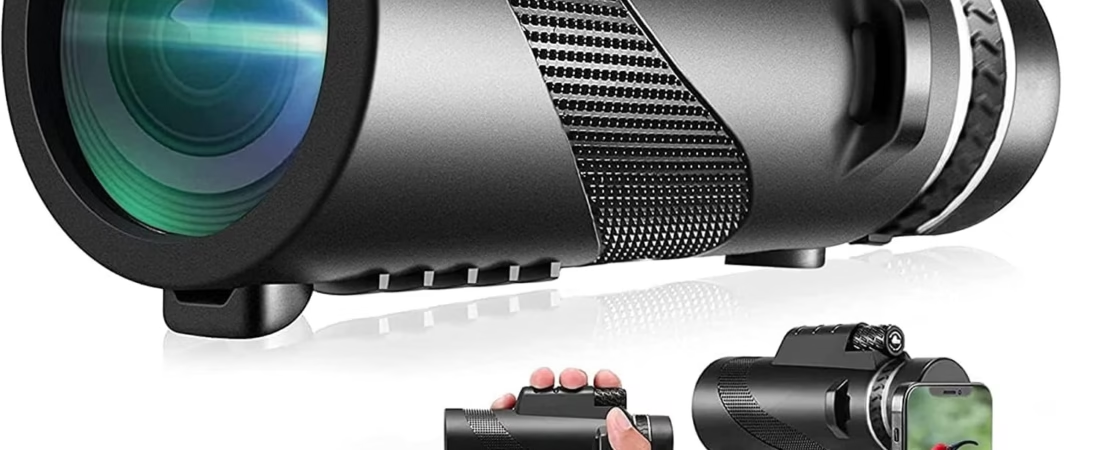
A monocular telescope can be a practical alternative to traditional binoculars when the goal is to observe distant subjects while carrying a relatively compact optical device. The Amazon product discussed here is described as an 80×100 high-powered monocular telescope for adults, with a high-definition viewing system and a smartphone adapter. It is marketed for activities such as wildlife observation, bird watching, travel, camping, hiking, and other outdoor situations.
The combination of a monocular and smartphone adapter is particularly interesting because it brings two functions together. The optical device provides a magnified view for the user, while the adapter can allow a compatible smartphone camera to capture images through the eyepiece.
The product title uses the specification “80×100,” but it is important to understand that numbers used in consumer optical products should be interpreted carefully. Magnification and objective diameter are separate concepts, and advertised magnification does not automatically describe the practical amount of useful detail that can be observed. Image quality also depends on lens design, optical alignment, light conditions, atmospheric conditions, focusing, and the quality of the attached smartphone camera.
For this reason, a useful approach to evaluating a high-powered monocular is to look beyond the largest number in the product name. Understanding how magnification works, how a 100mm designation is normally interpreted, how smartphone adapters function, and what limitations apply to long-distance observation can provide a much clearer picture of the product category.
This guide explores those subjects while focusing on practical, educational uses rather than treating the monocular as a direct replacement for every type of binocular, spotting scope, or telescope.
Understanding the 80×100 Description
The phrase “80×100” contains two numbers that are commonly used in descriptions of optical products.
The first number, 80x, refers to an advertised magnification level.
The second number, 100, generally refers to the approximate objective lens diameter in millimeters.
These measurements describe different parts of the optical system.
What Magnification Means
Magnification describes how much larger an object appears through the optical device compared with viewing it without magnification.
For example, a theoretical 10x optical system makes an object appear approximately ten times larger in angular terms than it would to the unaided eye.
An advertised 80x magnification would represent a very high level of enlargement if achieved as true optical magnification.
However, high magnification introduces several practical challenges.
Small movements of the user’s hands become much more noticeable. Atmospheric haze becomes more apparent. The field of view becomes narrower, and focusing becomes more sensitive.
This is why a high magnification number should not automatically be interpreted as meaning that the image will always contain more useful detail.
What the 100mm Number Usually Means
The second number in an “80×100” optical designation normally refers to the diameter of the objective lens in millimeters.
A 100mm objective would be substantially larger than the objective lenses commonly found on compact monoculars.
A larger objective can collect more light, which can be helpful under suitable lighting conditions.
However, the actual usefulness of a large objective depends on the complete optical system.
A larger front lens also generally means a larger and heavier device.
Because the available product information does not independently verify the exact optical construction behind the advertised 80×100 designation, it is more appropriate to treat these numbers as the manufacturer’s product description rather than assume that they represent laboratory-measured optical performance.
Key Features
High-Powered Monocular Design
The central feature is the monocular format.
Unlike binoculars, which provide separate optical paths for both eyes, a monocular is designed for viewing through one optical channel.
This can make the device relatively straightforward to use and can allow the manufacturer to concentrate the optical system into a single viewing path.
A monocular can also be convenient when the user wants to carry one optical instrument rather than a larger binocular setup.
The experience is different from binocular viewing, however.
With a monocular, one eye is doing the observation while the other remains outside the optical system.
Some users may prefer this arrangement because of its simplicity, while others may find binocular viewing more comfortable during long observation sessions.
Large Objective Concept
The product is identified as having a 100mm objective specification.
The objective lens is the front lens that gathers incoming light.
In general optical design, a larger objective can provide greater light-gathering potential.
This becomes relevant during early morning, late afternoon, or other situations where available light is reduced.
There is a practical trade-off.
A large objective requires more physical space and can increase the weight of the optical instrument.
For hiking or travel, this is an important consideration because every additional piece of equipment contributes to the weight and space carried in a backpack.
High-Definition Viewing
The product description emphasizes high-definition viewing.
In practical terms, image clarity is influenced by several factors rather than one “HD” label.
Important elements include:
- Optical glass quality
- Lens coatings
- Alignment
- Focusing accuracy
- Atmospheric conditions
- Available light
- Mechanical stability
- Magnification
- The observer’s eyesight
A high-definition designation should therefore be understood as part of the product description rather than a guarantee that distant subjects will remain perfectly detailed under all conditions.
Smartphone Adapter
The included smartphone adapter is one of the more practical features for modern outdoor observers.
A compatible smartphone can potentially be positioned behind the monocular’s eyepiece so that its camera captures the magnified image.
This is often called digiscoping.
Instead of simply looking through the monocular, the user can attempt to photograph or record what the optical system is showing.
The quality of the resulting photograph depends on the phone camera as well as the monocular.
A smartphone with a good camera sensor can produce useful images under suitable conditions, but the adapter must also hold the phone securely and keep the camera lens properly aligned with the eyepiece.
Smartphone Compatibility
A smartphone adapter is not automatically compatible with every phone.
Phone dimensions, camera placement, case thickness, and camera-lens position can all affect alignment.
A thick protective case may prevent the adapter from positioning the camera close enough to the eyepiece.
Multiple rear cameras can also create alignment issues because the adapter may need to be positioned over one specific camera rather than the entire camera module.
Users should therefore check the adapter’s compatibility with their particular smartphone before relying on it for photography.
Manual Focusing
A monocular intended for distant observation needs a way to bring subjects into focus.
Focusing becomes increasingly important at high magnification.
A slight change in distance can require a focus adjustment, and atmospheric haze can sometimes create the impression that a subject is out of focus even when the optical system is correctly adjusted.
Users should take time to focus carefully rather than assuming that maximum magnification will automatically produce the clearest image.
Portable Outdoor Format
The product is marketed for outdoor activities including hiking, camping, travel, bird watching, wildlife observation, and hunting-related observation.
A monocular can be easier to carry than a full-sized telescope.
However, the actual portability of a product described as having a 100mm objective depends on its physical dimensions and weight.
Users planning long hikes should consider the total weight of the device together with the smartphone adapter, protective case, tripod if needed, and other accessories.
How a Monocular Works
Understanding the basic optical path helps explain why several factors affect image quality.
The Objective Collects Light
Light from the distant scene enters through the objective lens.
The larger the objective, the greater the potential amount of light entering the system.
Internal Lenses Process the Image
The optical system redirects and enlarges the incoming image.
The arrangement of internal lenses determines how the final image is presented to the observer.
The Eyepiece Presents the Image
The eyepiece magnifies the intermediate image for the observer’s eye.
The user’s position relative to the eyepiece is important because improper positioning can result in a partially visible image or dark edges around the field.
The Smartphone Camera Can Capture the View
When the smartphone adapter is used, the phone camera is positioned behind the eyepiece.
The phone essentially photographs the image produced by the monocular.
This is different from using the smartphone camera’s own digital zoom.
The monocular provides optical magnification before the phone sensor records the image.
How It Can Be Used
Bird Watching
Bird watching is one of the most natural applications for a monocular.
Birds may be located high in trees, across open fields, or on distant shorelines.
A magnified optical system can make it easier to observe details that are difficult to see with the naked eye.
For bird watching, patience is often more important than maximum magnification.
A bird moving quickly through branches can be difficult to locate through a narrow, highly magnified field.
Lower practical magnification can sometimes make initial target acquisition easier.
Once the bird is located, additional magnification can be useful for observation.
Wildlife Observation
Wildlife can often be observed from a distance without approaching the animal.
A monocular can provide an opportunity to observe animals while maintaining an appropriate separation.
This can be particularly useful in open landscapes, nature reserves, mountains, forests, and wetlands.
Wildlife observers should avoid approaching or disturbing animals simply to obtain a closer image.
A long-distance optical device can actually support responsible observation by allowing the viewer to remain farther away.
Camping
A monocular can add another dimension to camping.
During daylight, it can be used to observe distant landscapes, mountain ridges, trees, or wildlife.
At dawn and dusk, it can help examine distant areas where ordinary vision may not provide the same level of detail.
It should not replace a flashlight or headlamp.
A monocular shows a magnified view but does not illuminate the ground in front of the user.
Hiking
Hikers may use a monocular to examine distant landscape features.
For example, a user might want to inspect a distant ridge, rock formation, or landmark before continuing along a trail.
This can be useful for recreational observation and orientation.
However, hikers should avoid using a high-magnification optical device while walking over difficult terrain.
Stop in a stable location before looking through the monocular.
Travel
Travelers often encounter landmarks that are easier to appreciate from a distance.
A monocular can be useful for viewing:
- Historic buildings
- Bridges
- Mountain landscapes
- Coastlines
- Towers
- Distant architecture
- Scenic overlooks
Its single-eye viewing format can also make it convenient when traveling light.
Landscape Observation
Long-distance landscapes can reveal details that are difficult to appreciate with unaided vision.
A high-powered monocular can be used to examine mountain slopes, cliffs, valleys, distant structures, and other scenic features.
Atmospheric haze is an important limitation.
A mountain several miles away may appear less detailed not because the optical device is inadequate, but because moisture and particles in the atmosphere scatter light between the observer and the subject.
Smartphone Photography
The smartphone adapter makes it possible to experiment with optical photography.
This can be especially interesting for:
- Birds
- Wildlife
- Landscapes
- Distant architecture
- Scenic viewpoints
- Moon observation
- Outdoor events
The smartphone’s camera records the image formed by the monocular.
Results can vary substantially depending on alignment and stability.
A tripod or other stable support may make a major difference when using high magnification.
Outdoor Events
Depending on the environment and applicable venue rules, a monocular can help observe distant areas at outdoor events.
However, large optical equipment may be restricted at some venues.
Always check event policies before bringing a telescope or monocular into a stadium, concert, protected site, or other controlled location.
Smartphone Photography Through a Monocular
What Is Digiscoping?
Digiscoping refers to photographing or recording through an optical instrument such as a spotting scope, telescope, binocular, or monocular.
The smartphone adapter acts as a mechanical bridge between the phone and the eyepiece.
Instead of using the phone camera by itself, the phone records the magnified optical image.
Why Alignment Matters
The camera lens must be positioned correctly behind the eyepiece.
If the phone is slightly off-center, the resulting photograph may contain:
- A dark circular border
- Heavy vignetting
- An uneven image
- Reduced brightness
- Partial obstruction
- Difficulty focusing
The adapter’s job is to keep the phone aligned.
Smartphone Cases Can Interfere
A thick phone case can prevent the camera from getting close enough to the eyepiece.
If this happens, the phone may capture a smaller circular image rather than filling the entire camera frame.
Some users may need to remove the case temporarily, depending on the adapter design.
Use the Main Camera
If the phone has several cameras, the primary camera may be the easiest to align with the monocular.
Switching between lenses can change the camera position relative to the adapter.
The phone’s camera application may also automatically change lenses depending on lighting and zoom settings.
Locking the desired camera mode, when the phone allows it, can help maintain consistency.
Avoid Excessive Digital Zoom
The monocular is already providing optical magnification.
Adding large amounts of smartphone digital zoom can enlarge imperfections and reduce image quality.
A better approach is generally to achieve the desired framing through optical alignment first and then use modest digital adjustments if necessary.
The Importance of Stability
High magnification makes movement much easier to notice.
Even a small hand movement can cause the image to move substantially across the smartphone screen.
This becomes particularly important when photographing distant wildlife or birds.
A tripod can help provide a stable platform when the device supports suitable mounting equipment.
Even when a tripod is unavailable, resting the monocular against a stable surface can reduce movement during observation.
However, the device should be positioned safely and securely.
Who It May Be Suitable For
Bird Watchers
People interested in casual bird observation may appreciate the ability to examine distant birds without carrying full-sized binoculars.
Wildlife Enthusiasts
Wildlife observers can use the monocular to watch animals from an appropriate distance.
Travelers
Travelers who frequently visit scenic locations, mountains, coastlines, and architectural landmarks may find a compact optical instrument useful.
Campers and Hikers
Outdoor enthusiasts can use a monocular for landscape observation and distant viewing during camping or hiking activities.
Smartphone Photography Hobbyists
The smartphone adapter makes the product relevant to people who enjoy experimenting with optical photography.
Beginners Exploring Outdoor Optics
A monocular can provide a relatively accessible introduction to magnified outdoor observation.
However, beginners should understand that extremely high advertised magnification can require more careful technique than lower-power optics.
Important Things to Consider
Treat the 80x Claim Carefully
The product title identifies the monocular as 80×100.
Consumers should distinguish between advertised magnification and practical resolving power.
Very high magnification can make an image larger without creating additional detail.
If the original image contains insufficient information, magnifying it further cannot recreate missing detail.
Atmospheric Haze Can Limit Long-Distance Viewing
The atmosphere itself becomes an optical obstacle over long distances.
Dust, humidity, heat shimmer, fog, and pollution can reduce contrast.
This is especially important when viewing distant mountains or wildlife across large open spaces.
Higher Magnification Narrows the Field of View
A very highly magnified image generally shows a smaller portion of the surrounding scene.
This can make it harder to locate a moving bird or animal.
For fast-moving subjects, target acquisition can be more difficult at extremely high magnification.
Stability Is Critical
Handheld use becomes increasingly challenging as magnification rises.
For extended observation or smartphone photography, stable support can significantly improve usability.
Objective Size Affects Portability
A 100mm objective is relatively substantial for a monocular.
Before taking the device on a long hike, consider its total size and weight along with accessories.
Smartphone Adapters Are Mechanical Accessories
The adapter needs to hold the phone securely.
An improperly fitted phone could fall or become damaged.
Check compatibility and make sure the phone is properly secured before lifting or moving the complete setup.
Do Not Look at the Sun
This is one of the most important safety considerations for any magnifying optical instrument.
Never point a monocular, telescope, binocular, camera lens, or similar optical device directly at the Sun.
Magnification concentrates sunlight and can cause severe and permanent eye injury.
This warning applies even when a smartphone is attached.
A phone camera does not make direct solar viewing safe.
Be Careful Around Bright Lights
Extremely bright artificial light sources can also create uncomfortable or damaging viewing conditions depending on their intensity.
Avoid using the optical device in ways that expose the eyes to unsafe light levels.
Respect Privacy
A high-powered monocular can make distant objects easier to see.
That capability should be used responsibly.
Do not use optical equipment to intentionally observe people in private spaces or otherwise invade their privacy.
Consider Local Regulations
Rules concerning hunting, wildlife observation, protected areas, private property, and optical equipment can vary by location.
The device itself does not determine whether a particular activity is permitted.
Users should follow applicable laws, property rules, wildlife regulations, and venue policies.
Comparison of General Optical Categories
Monocular vs. Binoculars
Binoculars use both eyes.
They can provide a comfortable viewing experience during extended observation and make it easier for some people to maintain awareness of the surrounding scene.
A monocular uses one optical channel.
Its advantages can include a simpler physical format and potentially easier storage.
For bird watching and general nature observation, either category can work well depending on the user’s preferences.
Monocular vs. Spotting Scope
A spotting scope is generally designed for more stationary, high-detail observation.
Many spotting scopes are used with tripods because higher magnification makes stability important.
A monocular can be more convenient for portable observation.
The tradeoff is that extremely high-detail applications may benefit from the more specialized design of a spotting scope.
Monocular vs. Telescope
Astronomical telescopes are specifically designed around observing celestial objects.
They often use specialized mounts and accessories.
A general-purpose monocular is more oriented toward terrestrial observation.
Although the product is described using the word “telescope,” users should not automatically assume that a consumer monocular is equivalent to a dedicated astronomical telescope.
Optical Monocular vs. Smartphone Zoom
A smartphone zoom system enlarges an image electronically or switches between built-in camera lenses.
A monocular provides magnification through an optical system before the phone records the image.
The two can be combined through a smartphone adapter.
This can provide a different result from using smartphone zoom alone.
High-Power Monocular vs. Compact Travel Monocular
A compact travel monocular prioritizes portability.
A larger optical system may prioritize light collection and magnification potential.
The larger design can be more demanding to carry.
For frequent hiking, portability may be more important than maximum optical specifications.
Improving Observation Results
Observe in Good Lighting Conditions
Even a high-powered optical system benefits from sufficient available light.
Daylight often provides the strongest conditions for detailed observation.
Start With a Wider View
If the device allows a lower magnification setting, starting with a wider field can make it easier to locate the subject.
Once the subject is centered, additional magnification can be used if needed.
Focus Carefully
Take time to achieve the clearest possible image.
Small focus adjustments can have a noticeable effect when observing distant objects.
Stabilize the Device
Use a steady grip or stable support.
For smartphone photography, stability becomes even more important.
Keep the Optics Clean
Fingerprints and dust can reduce contrast.
Use appropriate optical-cleaning materials rather than abrasive household materials.
Avoid Heat Sources
Heat shimmer can distort distant views.
This is particularly noticeable when observing across roads, rooftops, open fields, or other surfaces heated by the sun.
Give Your Eyes Time
When moving between different lighting environments, allow your eyes time to adapt.
This can make low-light observation more comfortable.
Using the Monocular for Wildlife Observation Responsibly
Optical equipment can make wildlife observation more accessible, but responsible behavior remains important.
Maintain a reasonable distance from animals.
Avoid chasing animals to obtain a better view.
Do not use bright lights or other disruptive methods simply to improve an image.
During breeding, nesting, or migration periods, extra caution may be necessary because disturbance can have greater consequences.
The ability to see an animal from far away should be used as a reason to maintain distance, not as an invitation to approach.
Using It for Hiking and Camping
For outdoor activities, the monocular should be considered part of a larger equipment system.
A typical hiking setup may also include:
- Water
- Appropriate clothing
- Navigation equipment
- First-aid supplies
- Communication equipment
- Flashlight or headlamp
- Weather protection
The optical device can add observation capability but does not replace essential safety equipment.
When walking, put the monocular away before crossing difficult terrain.
Stop at a safe location, observe, and then continue.
Frequently Asked Questions
What does 80×100 mean on a monocular?
The product is marketed with an 80×100 designation. In conventional optical terminology, the first number represents magnification and the second generally refers to objective lens diameter in millimeters.
Is 80x magnification always better than lower magnification?
No. Higher magnification can enlarge a distant subject, but it also narrows the field of view and makes movement, atmospheric distortion, and focusing more noticeable.
What is the purpose of the 100mm objective?
The objective is the front lens. A larger objective has greater light-gathering potential, although overall image quality depends on the complete optical system.
Can this monocular be used for bird watching?
The product is marketed for bird watching and wildlife observation. A monocular can be useful for viewing birds at a distance, although very high magnification can make it more difficult to locate fast-moving subjects.
Can it be used for wildlife observation?
Yes. Wildlife observation is one of the intended outdoor applications described in the product title.
Users should maintain appropriate distances and avoid disturbing animals.
Does the product include a smartphone adapter?
The product title identifies a smartphone adapter as part of the product configuration.
The exact compatibility should be checked for the specific smartphone model.
Can I take pictures through the monocular?
A compatible smartphone adapter can allow the phone camera to capture the image viewed through the monocular.
This technique is commonly known as digiscoping.
Why does my smartphone image have a black circle around it?
This can happen when the phone camera is not properly aligned with the eyepiece or when the camera is positioned too far away.
Adjusting the adapter position may improve alignment.
Will every smartphone work with the adapter?
Not necessarily.
Phone size, camera placement, case thickness, and adapter dimensions can affect compatibility.
Can I use the smartphone’s digital zoom?
You can potentially use digital zoom, but excessive digital enlargement may reduce image quality.
It is generally preferable to establish proper optical alignment first.
Do I need a tripod?
Not necessarily for casual observation, but stable support can be helpful at high magnification and particularly useful for smartphone photography.
Is this monocular suitable for hiking?
It is marketed for hiking and outdoor use. Users should consider the physical size and weight of the specific unit when planning longer hikes.
Can it be used for camping?
Yes. Camping and outdoor observation are among the applications associated with this product category.
Can it be used for travel?
A monocular can be useful for viewing distant landmarks, landscapes, architecture, and other travel subjects.
Can it be used at night?
A standard optical monocular does not automatically provide night vision.
Low-light performance depends on the optical design and available ambient light.
Users should not assume that a high magnification specification means the device has night vision.
Can it be used for astronomy?
It may allow observation of some bright celestial objects, depending on the optical system and conditions, but a general-purpose monocular should not automatically be considered a substitute for a dedicated astronomical telescope.
Can I look at the Sun through it?
No.
Never look directly at the Sun through a monocular or any other unfiltered magnifying optical device. Serious and permanent eye injury can occur.
Can I photograph the Moon through it?
The Moon can be photographed through suitable optical equipment when the equipment is properly aligned and safely used.
The phone camera’s exposure settings and the stability of the setup can strongly affect the resulting image.
Why does the image shake so much?
High magnification magnifies apparent movement as well as the subject.
Handheld use can therefore become difficult at high magnification.
Why does a distant mountain look blurry?
Atmospheric haze, humidity, dust, heat shimmer, and other conditions can reduce contrast over long distances.
The optical device cannot remove all atmospheric interference.
Does high magnification create additional detail?
No.
Magnification enlarges the available visual information, but it cannot create genuine detail that the optical system and environment did not capture.
What is digiscoping?
Digiscoping is the practice of taking photographs or video through an optical device such as a monocular, spotting scope, telescope, or binocular.
Should I remove my phone case?
A thick phone case can sometimes interfere with proper adapter alignment. Whether removal is necessary depends on the adapter and smartphone.
How should the monocular be cleaned?
Use appropriate optical-cleaning materials and avoid abrasive surfaces. Dust should be removed carefully rather than rubbed across the lens.
Can I use it through a vehicle window?
You can observe through a window, but glass can introduce reflections, distortion, and reduced image quality. Opening the window or observing from outside may produce a clearer view when conditions permit.
Is the monocular suitable for children?
The product is described as being for adults. Children should not use high-powered optical equipment without appropriate adult supervision, particularly because of the risk of unsafe viewing of the Sun or other bright sources.
Is it suitable for hunting?
The product title mentions hunting among its intended applications. Any hunting-related use must comply with local laws, seasons, licensing requirements, property rules, and wildlife regulations.
Can it replace binoculars?
Not necessarily.
A monocular and binoculars offer different viewing experiences. Some users prefer one-eye observation, while others prefer the comfort of using both eyes.
Is it the same as a spotting scope?
No.
A spotting scope is a more specialized optical category, often designed for stable, detailed long-distance observation. A monocular can provide a more portable alternative depending on the design.
Conclusion
The 80×100 high-powered monocular telescope discussed here is designed around a combination of magnified optical observation and smartphone compatibility.
Its product description emphasizes high-powered viewing, high-definition imagery, a smartphone adapter, and outdoor applications including wildlife observation, bird watching, travel, camping, hiking, and other activities where distant subjects are worth examining more closely.
The smartphone adapter adds another dimension to the device. Instead of simply viewing a distant subject through the eyepiece, a compatible phone can potentially capture the optical image. This makes the monocular relevant not only to people interested in observation but also to casual outdoor photography and digiscoping.
At the same time, the specifications should be interpreted realistically.
An “80×100” designation does not by itself guarantee that every distant object will appear highly detailed. Extremely high magnification can make the image harder to stabilize, narrow the field of view, and make atmospheric conditions more obvious. The objective size can provide light-gathering potential, but the final image depends on the entire optical system.
For bird watching, wildlife observation, and scenic viewing, the ability to magnify distant subjects can be useful when combined with patience, good lighting, stable positioning, and realistic expectations.
The smartphone adapter can also make experimentation with optical photography accessible, although successful digiscoping depends heavily on precise alignment and a stable setup.
Safety remains particularly important. A monocular should never be pointed directly at the Sun, and users should respect privacy, wildlife, property boundaries, venue rules, and applicable local regulations.
For someone researching a portable optical instrument for outdoor observation, the most useful way to evaluate this type of product is to consider the complete experience rather than focusing exclusively on its largest advertised number. Magnification, objective size, optical clarity, stability, focusing, portability, smartphone compatibility, and intended use all matter.